Independent Screenplays Finding Global Reach Through Festival Routes

Mid-tier original screenplays occupy a distinct space in the film industry, where budgets typically range between five and thirty million dollars and stories originate from writers rather than established franchises. These projects often begin their journey at festival premieres, where they attract distributors and build initial audience interest before expanding into wider markets. Research from the European Audiovisual Observatory shows that such films accounted for eighteen percent of theatrical releases across member states in 2025, with many securing additional revenue through streaming platforms in subsequent years.
Festival circuits serve as primary launch points because they provide curated environments for critical evaluation and networking. Events such as the Sundance Film Festival and the Toronto International Film Festival schedule dedicated slots for these titles, allowing buyers to assess audience reactions in real time. Data collected during the 2025 edition of Sundance indicated that thirty-two percent of mid-tier original entries secured distribution deals within ninety days of their world premiere, compared with twelve percent for higher-budget studio productions.
Festival Selection and Early Momentum
Selection committees prioritize scripts that demonstrate narrative originality alongside commercial viability, which means strong character arcs and contained settings often receive preference over large-scale visual effects. Once accepted, these films benefit from programmed panels and industry meetings that connect producers directly with sales agents. Observers note that a strong festival debut frequently generates trade coverage, which in turn influences later booking decisions at multiplex chains and subscription services.
Pathways diverge after the initial screenings. Some titles move to regional festivals in Europe and Asia to accumulate additional awards and press, while others proceed straight to limited theatrical rollouts in key territories. A 2024 study published by the University of Southern California documented that films following a multi-festival strategy achieved twenty-seven percent higher international box-office totals than those limited to a single major event.
Distribution Transitions and Platform Expansion
Distribution agreements secured at festivals typically include clauses for both theatrical windows and subsequent streaming availability. Mid-tier originals benefit from this hybrid model because their modest marketing budgets align well with targeted digital campaigns rather than broad television advertising. Figures released by the Motion Picture Association in early 2026 reveal that non-English-language mid-tier titles experienced a thirty-nine percent increase in global streaming hours during the first half of the year, driven largely by festival momentum.
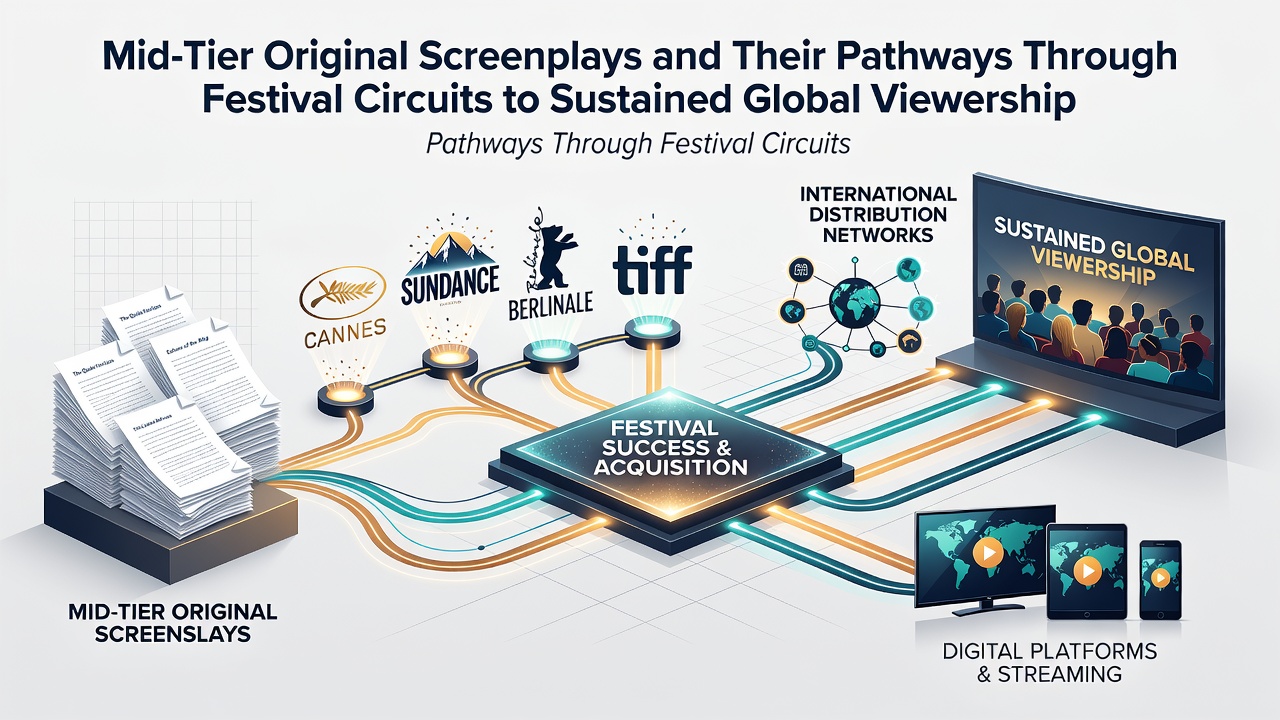
July 2026 marks the scheduled opening of several summer festivals in Australia and Canada, where programmers have already announced increased allocations for original screenplays. These events coincide with platform negotiations that often finalize during the same period, allowing simultaneous theatrical and on-demand releases in select markets. Industry reports indicate that coordinated timing helps sustain viewer interest beyond the initial festival buzz.
Long-Term Viewership Patterns
Sustained global viewership depends on ancillary revenue streams that festivals help initiate. Catalog licensing, educational screenings, and international television sales extend the lifespan of these projects for years after their premiere. A longitudinal analysis conducted by the Canadian Media Fund tracked twenty-seven mid-tier originals from 2022 through 2025 and found that festival-awarded titles maintained an average of four active distribution windows three years post-release, compared with two windows for titles without festival exposure.
Regional release strategies further influence longevity. Markets in Latin America and Southeast Asia have shown particular receptivity to story-driven originals that avoid reliance on visual spectacle. Distributors therefore schedule staggered openings that allow word-of-mouth to build across time zones, supported by localized subtitling and dubbing completed during the festival phase. This approach has contributed to measurable upticks in repeat viewings on streaming platforms, according to aggregated data from multiple service providers.
Conclusion
The route from festival circuit to sustained global audiences for mid-tier original screenplays follows predictable yet adaptable patterns shaped by selection processes, distribution timing, and ancillary market exploitation. Data consistently demonstrates that early festival validation correlates with extended revenue cycles across theatrical, streaming, and television platforms. As additional summer events unfold in 2026, the same mechanisms are expected to guide the next cohort of projects toward comparable international reach.